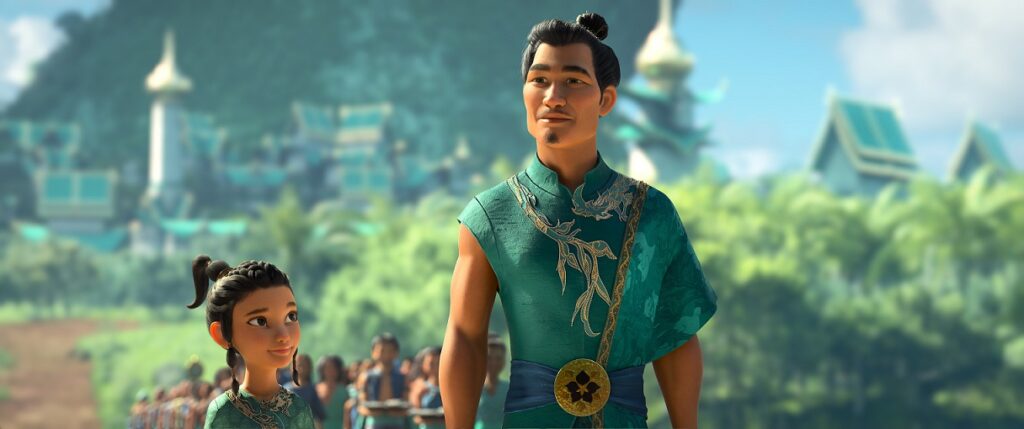
Listen, if we don’t stop and learn to trust one another again, it’s only a matter of time before we tear each other apart. This isn’t the world I want you to live in. I believe that we can be Kumandra again. But someone has to take the first step. Trust me.
Benja in Raya and the Last Dragon
Raya and the Last Dragon seems to be a hit in Asian American communities in the U.S., and it is a good and entertaining movie for children. The movie deserves countless praises. Southeast Asian representation, artists’ attention to details (Disney/Pixar artists rarely disappoint me), strong female characters, the list can go on. As an Asian myself, though not a Southeast Asian, I still feel the pride for Asians in general. They deserve to be seen, and their culture deserve to be broadcasted in a platform like Disney.
OK. I said that. It will ease my guilt of writing the following, and also clarifies that my “complaints” about this movie has nothing to do with the culture or the people represented in the movie.
I found the message of the movie, especially the ending, TROUBLING. What are we teaching our children now?
Disney movies — I’m talking about the ones with a princess or 2 — have come a long way since Snow White. When Elsa tells Anna “You can’t marry a mean you just met”, the entire world exploded: It is a small step for Elsa and Anna, but It is a HUGE step forward for Disney! We are finally teaching our children about the real world!

Then came Sisu the dragon who believes in the best of people and Raya the princess who decides to “take the first step” and leaves her life and her world’s fate in the “villain”‘s hands. It is a step forward for many different things, but it is also a big step backward for Disney — we are back to the fairy tale land.
I am happy for Raya and her world to finally find their unity and trust in each other, but I am very confused about how the movie comes to that ending, and horrified by the message this movie sends to the children: take a leap of faith and trust people, and they will do the right thing, regardless of what they have done before.
Really?
Then what happens to Raya’s father, Benja, in the movie? Though Raya is the one who exposes Sisu’s gem’s location, Benja’s idealism is the root cause of the tragedy happens afterwards. As the leader of the tribe who owns the most coveted gem, he wants to eliminate the misunderstanding among five tribes and unite them all, which takes courage, wisdom and vision. Yet he clearly doesn’t understand human nature and does not even bother to set up proper protection for the gem when inviting potential thieves into his home.
Raya learns the lesson of trusting people easily because of the traumatic experience, only to find a dragon who is as idealistic as her father. Raya agrees to meet Namaari because Sisu tells her to take a chance, and the result? Namaari kills Sisu and almost completely ruins the world. So far it doesn’t go so well for people who believe in the best of human nature. Yet Raya decides to trust Namaari one more time — it is probably the biggest gamble in that world’s history. Though it pays off in the end, Raya’s gambit isn’t justified.
Because just like you should not marry a man you just met, you should not trust people who have a history of not being trustworthy with big responsibilities — hold it right there, before everyone comes for my blood — it is not to say we should not give people second chances. We all deserve and need second chances, but we also need to work for others’ trust. Even a leap of faith needs a stepping stone to leap from.
But the movie doesn’t have much time for Namaari’s redemption arc, so it only made so it makes it look like Namaari decides to do the right thing because of the immense trust Raya and the others have for her. But is it? There is a bigger chance that Namaari “reciprocate” the trust simply because the shatter gem pieces are not going to save her from the Druun for much longer anyway; it is simply her last resort and has nothing to do with her redemption worthiness.
Therefore, the utopian ending of Raya’s world is as fragile as the “they lived happily ever after” endings of the old Disney movies, idealistic and unrealistic. The conclusion of us moving from Cinderella to Frozen, then to Raya, is that we decide to confront the reality of true love, yet dodging the reality of selfishness; we applause the practicality in proposing, while downplaying the practicality in dealing with human nature.
Both as human race and as the United States, we face unprecedented challenges when it comes to unity. So I understand and appreciate what Disney is trying to do. But an oversimplified world view about “taking the first step to trust someone” will not help adults nor children to navigate in the turmoil of all the political arguments, ideology fights and diplomatic struggles around us. We shall always hope that the good side of human nature can prevail, but instead of asking people to trust others, how about asking everyone to earn the others’ trust first? If our children understands the importance of building the foundation of trust, they will also understands when they can or shall take a leap of faith at the others.
Human nature is always going to be two sided and, for lack of better words, “muddy”. But the ending of Raya and the Last Dragon, however improbable, should be something human race strive for as a whole.
 Not Born American